Sustainability
Environment, climate and resources
We at Electrocycling are committed to making exactly this possible. With our activities in the field of processing old electrical equipment and extracting secondary raw materials, such as copper, iron and aluminium, plastics, glass and precious metals, we would like to make a contribution to the manufacture of sustainable products and the conservation of natural resources. Our claim is to actively support the global task of sustainability by promoting the circular economy.
Today, recycling 25 tonnes of old electrical appliances alone saves the mining of 300 tonnes of ore to recover about one tonne of copper, 10 tonnes of iron and a few grammes of gold!

The best for the environment
Our location on the edge of the Harz National Park is a constant reminder of the importance of environmental protection.
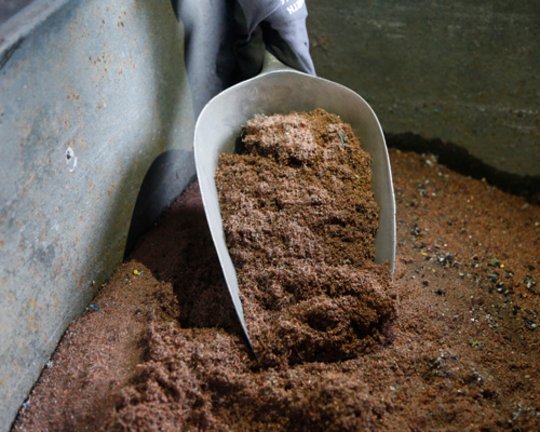
We rely on state-of-the-art technologies for resource-saving recycling, the recovery of raw materials and the recovery of components from old appliances.
In the preliminary stages, we offer manufacturers advice on the development of new products with regard to environmental compatibility and recycling-friendly design in order to achieve optimum recyclability during disposal.
Taking into account all ecological framework conditions, our environmentally friendly secondary raw material recovery saves money and, above all, secures primary raw materials. You can find out more about our approach in the Distribution section. In addition, you can take a look at the Values section to know how we actively support the topics of climate protection and sustainability.
Climate protection
We at Electrocycling understand that climate protection is one of the most important global issues of our time, and are keen to make our contribution to that end.
We do this by returning the metals and plastics we recover through recycling to the economic cycle so that they can be used for the production of new products.
In this way, we shorten transport distances compared to sourcing natural resources that often do not occur in Germany, save fuel and reduce greenhouse gas emissions through the associated lower CO2emissions.
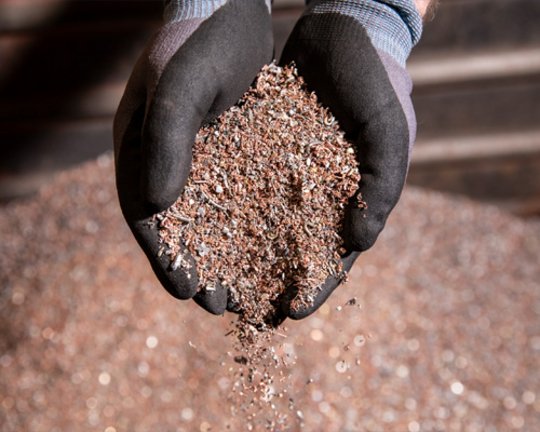
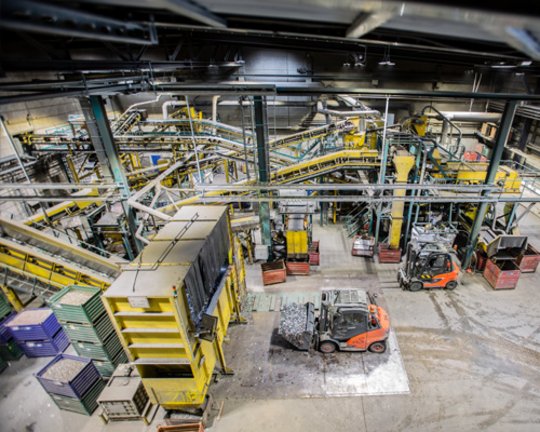
Even during processing in our facilities, we ensure not only a reduction in energy consumption but also a related reduction in CO2emissions through energy-efficient production processes, e.g. when loading the system for optimal capacity utilisation.
Secondary metal extraction plays an important role in reducing CO2emissions, as it can save significant amounts of CO2 compared to primary extraction. For example, using one tonne of steel scrap saves slightly more than 1.5 times this amount of CO2. In the area of secondary aluminium, the saving is about 9 tonnes, and in the area of the use of copper from secondary recovery, an even higher saving of CO2 can be achieved.
Furthermore, Electrocycling maintains an energy management system in accordance with ISO DIN 50001 in order to be able to internally identify potential savings in energy consumption in any form and to react accordingly. We also aim to use energy more efficiently.
As far as possible, we try to save energy and use it sensibly. In this context, we have already been able to achieve some successes internally.
Here is how it works
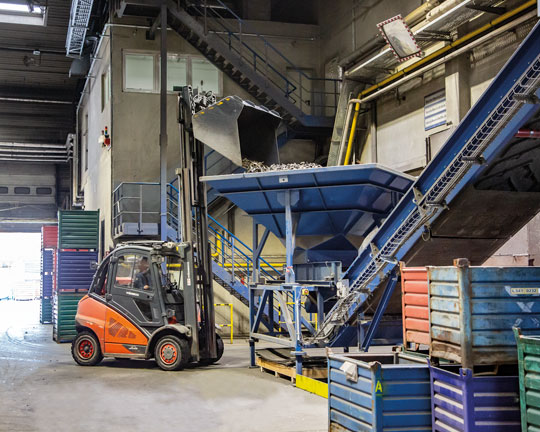
In the early 1990s, Electrocycling developed techniques and strategies to recycle waste electrical equipment with a minimum of manual labour and as much mechanisation as possible.
Acceptance/sorting
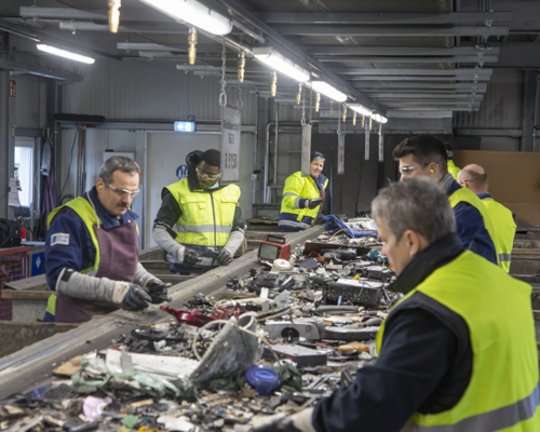
WEEE that reaches us from municipal collection points, commercial customers, waste management companies or from manufacturer or dealer take-backs is first sorted into:
- Equipment for reuse
- Equipment containing harmful or contaminating substances for disassembly
- Equipment for mechanical processing
Reuse
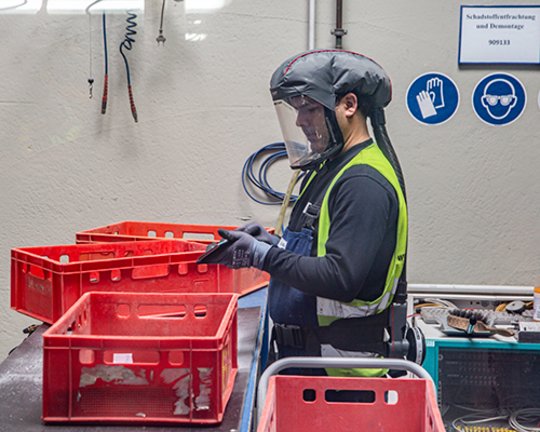
Functional appliances or parts that can be used as spare parts are tested, cleaned and packaged for further use.
Disassembly
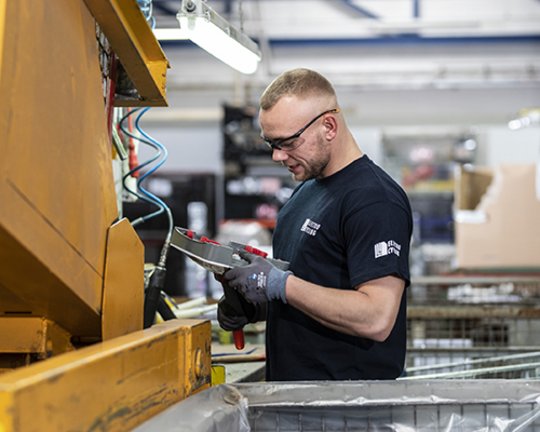
Disassembly is used to separate spare parts and harmful and interfering substances, such as batteries, capacitors, components containing mercury, liquids, etc., in order to prepare the unit components for subsequent mechanical reprocessing.
The disassembly s done manually, with the help of adapted tools and appropriate devices for certain devices and pollutants. The separated parts and pollutants are forwarded to suitable processing plants.
Mechanical processing
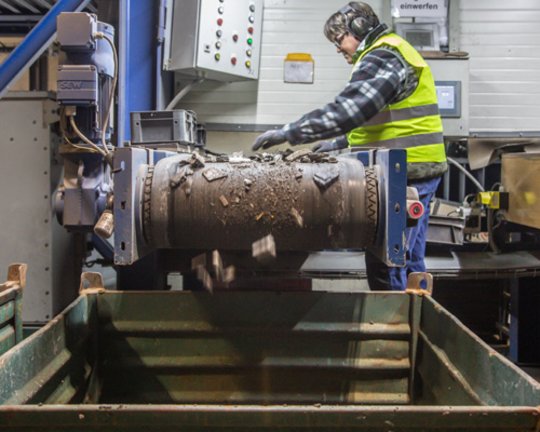
Equipment and assemblies that are free of pollutants are processed further in mechanical processing. A multi-stage shredding process separates the compounds and materials present. After each separation process, free materials such as iron, aluminium, copper or plastics are separated. Composite materials are further comminuted in the next stage. The respective disassembly after the individual comminution stages is carried out by physical processes adapted to the material composition and grain size, such as classification, magnetic and eddy current separation or density separation. The process technology used exploits the material properties and grain sizes to produce marketable secondary raw materials. This involves
- Iron
- Aluminium
- Stainless steel
- Copper concentrates
- Zinc
- etc.
These are used directly in the corresponding metal smelters to manufacture new products.
Furthermore, various plastics are sorted out and fed to plastics processors.
Residual materials and dusts containing ceramics, rubber, composite materials, thermosets, etc. that remain after the treatment process are sent for energy recovery.
Material flow management
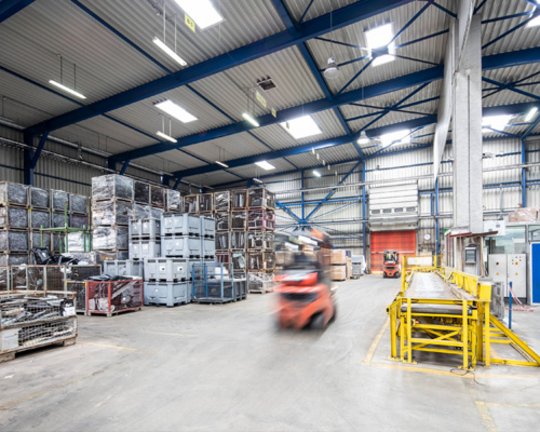
Just as important as the quality of the recycling processes is the quality of the collection and electronic processing of the process data. Electrocycling has a closed-loop system that ensures the collection of all relevant data, from collection to initial treatment to recovery rates, and enables their evaluation according to different requirements.
Our specially adapted software as well as the extensive data collection ensure a customer- and material-specific balancing of all material flows.
The administration of the collection containers and the coordination of the transport orders is carried out centrally by Electrocycling.
Many years of experience from projects with up to 2,500 collection points confirm the efficiency of our system. The tracking of product flows, the balancing and the preparation of data for the client are guaranteed by the system.

Innovation
Electrocycling ranks as one of the most innovative companies in the field of WEEE processing in Europe.
The process technologies used are continuously reviewed and optimised. At the same time, Electrocycling is constantly monitoring innovations in the field of electrical appliance development in order to be able to react to changes in appliance design at an early stage and to be able to provide the best recycling solutions for tomorrow's technology with foresight.
Electrocycling is continuously involved in working groups and associations to shape technical and legal requirements for the recycling of electrical appliances.
Electrocycling is also involved in various R&D (research and development) projects together with manufacturers, universities and research institutes.